The Cure for the $213,000 Mirage: Why Zillow and Redfin Can’t Agree on Your Home’s Value — And How a Broker Price Opinion Eliminates the Guesswork
In the age of instant everything, homeowners expect their most valuable asset to come with a simple number. Type in an address, hit enter, and — presto — Zillow’s Zestimate or Redfin’s Estimate spits out a figure that feels authoritative, scientific, even comforting. But what happens when those two “authoritative” numbers clash by more than two hundred thousand dollars? | QUICK ORDER

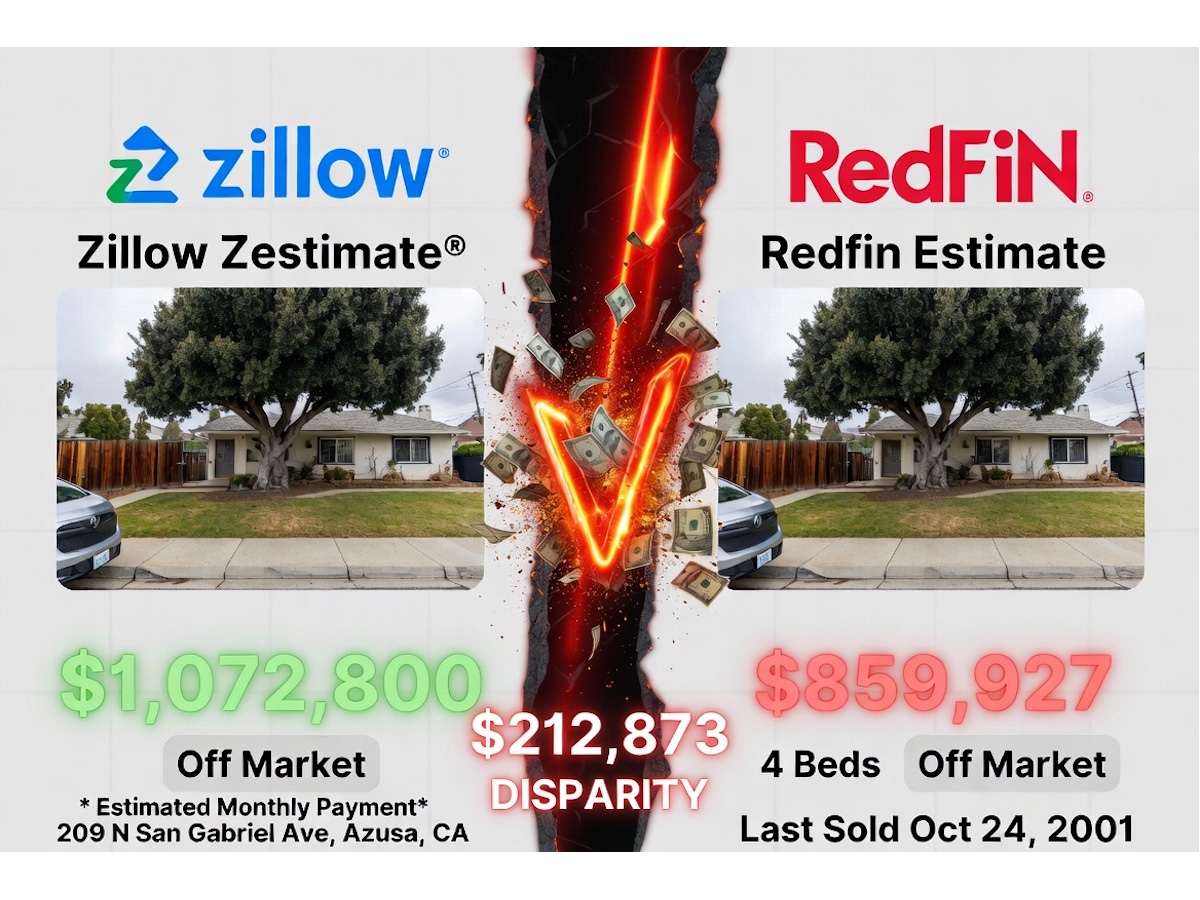
Look no further than 209 N San Gabriel Ave in Azusa, California. One side-by-side valuation shows Zillow confidently declaring $1,072,800. Directly across the digital divide, Redfin pegs the same off-market property at $859,927. That’s a $212,873 — roughly $213,000 — gulf on a single-family home last sold in October 2001. The photos appear identical: seems to be the same modest single-story house largely hidden behind a massive, character-defining evergreen tree, the same wooden fence, the same street view. Yet the algorithms disagree so dramatically that the listing headline might as well scream, “$1 Million or $800,000?”
This isn’t an anomaly. It’s a symptom of a much larger problem plaguing residential real estate in 2026: the over-reliance on automated valuation models (AVMs) that promise precision but frequently deliver confusion, frustration, and costly mistakes.
The Seductive Promise of Algorithmic Certainty
Zillow launched the Zestimate in 2006. Redfin followed with its own estimator, and today virtually every major portal offers some version of an instant home-value tool. They’re powered by sophisticated machine-learning models trained on public records, tax assessments, recent sales (“comps”), square footage, bedroom/bathroom counts, and whatever user-submitted or MLS-adjacent data they can scrape.
For on-market homes, the median error rates are impressively tight — Zillow around 1.9–2.4%, Redfin often claiming 1.99–2.2%. Half the time, the final sale price lands within a couple of percentage points. That’s useful for casual browsing or refinancing curiosity.
But flip the switch to off-market properties — the vast majority of American homes — and the picture darkens. Error rates balloon to roughly 7% for both platforms. On a $900,000–$1 million property, that’s a swing of $63,000 or more in either direction. And when the two platforms’ methodologies diverge (Zillow draws from broader, sometimes crowdsourced data; Redfin leans harder on MLS feeds), the gap can explode into six figures, exactly as it did in Azusa.
Why the Machines Disagree — And Why It Matters
Algorithms are only as good as their inputs and assumptions. Here’s where they stumble, often spectacularly:
- Data Blind Spots: AVMs can’t walk inside your home. They don’t know about the updated kitchen you installed in 2022, the leaky roof you just repaired, or the solar panels hidden behind that giant tree. They certainly don’t factor in how that tree itself might be perceived — a majestic selling feature to some buyers, a maintenance nightmare or view-blocker to others.
- Hyper-Local and Temporal Blindness: Markets move fast. A single blockbuster sale or a sudden inventory spike in Azusa or neighboring communities can shift comps overnight. Off-market homes like the San Gabriel property, untouched by the market for a quarter-century, leave the models guessing based on stale or distant data.
- Unique Properties Defy Patterns: Tract homes in cookie-cutter neighborhoods are easier for machines. But any home with character — unusual lot shape, mature landscaping, architectural quirks — throws off the statistical models. The Azusa house, partially obscured and long-held, is a textbook example.
- Algorithmic Philosophy Differences: Zillow and Redfin weight variables differently. One might emphasize recent sales volume; the other might prioritize assessed values or geographic smoothing. The result? The same property, two dramatically different stories.
The human cost is real. Sellers who trust the higher Zestimate might list too aggressively and watch their home sit, accruing carrying costs and buyer fatigue. Buyers relying on the lower Redfin figure might lowball and lose the deal to someone who did deeper homework. Lenders and appraisers, who ultimately have the final say, often land somewhere in between — or closer to the conservative side — triggering appraisal gaps that kill financing and transactions. In California’s already competitive, regulation-heavy market, these discrepancies don’t just confuse; they cost people tens or hundreds of thousands of dollars in missed opportunities, overpayments, or failed escrows.
Relying on that $213,000 algorithmic chasm isn’t just confusing — it’s an expensive gamble.
Homeowners who base major financial decisions on whichever online estimate flatters them most (or the one that appears first in a Google search) risk leaving tens or even hundreds of thousands of dollars on the table. Price a home $200k too high based on an optimistic Zestimate and you could watch it sit on the market for months, accruing mortgage payments, property taxes, insurance, and maintenance costs while buyer interest cools. Price it $200k too low based on a conservative Redfin figure and you may literally give away a substantial portion of your family’s wealth in a single transaction. In either case, the real waste isn’t just the valuation error itself — it’s the preventable financial damage that follows when sellers and buyers treat flashy but inconsistent AVM numbers as gospel instead of investing in a professional, objective valuation from the start. In today’s market, that kind of blind trust in Silicon Valley algorithms can easily cost far more than the price of getting an accurate Broker Price Opinion.
The Broker Price Opinion: Where Silicon Valley Meets Street-Level Expertise
Save a bundle by getting closer to the truth! Take advantage of the most cost-effective valuation method, the Broker Price Opinion (BPO) — a professional, licensed real estate broker’s detailed valuation that sits in the sweet spot between a quick AVM and a full-blown (and expensive) appraisal.
A BPO isn’t a computer model. It’s a human expert’s reasoned opinion, grounded in:
- Recent, hand-picked comparable sales adjusted for condition, location, and unique features.
- Drive-by or interior analysis of the subject property.
- Current market trends, buyer psychology, and neighborhood micro-dynamics that algorithms simply cannot replicate.
- Local knowledge of school districts, flood zones, HOA rules, and the intangible “feel” of a street that only boots-on-the-ground professionals develop over years.
BPOs have long been used by banks for short sales, pre-foreclosures, and portfolio valuations precisely because they deliver defensible, accurate figures at a fraction of appraisal cost and time. Today, savvy homeowners, investors, and even estate planners are turning to them for listing strategy, refinancing negotiations, divorce settlements, and pre-market planning.
Unlike AVMs, a BPO doesn’t guess about that massive tree or the home’s true curb appeal. It doesn’t extrapolate from a database that may be missing the last three high-end sales in Azusa. It tells you what a knowledgeable buyer would actually pay — today.
Corey Chambers: The California Broker Closing the Valuation Gap
Few professionals have turned BPOs into a precision tool quite like Corey Chambers, Broker, DRE #01889449, founder of Entar® Real Estate and Financial Tech, and a 15-year veteran of California’s fiercely competitive markets throughout the state — Northern, Central and Southern California.
Chambers, whose work spans Downtown Los Angeles lofts to suburban properties like the one in Azusa, to desert homes, commercial properties and raw land, has built his reputation on bridging the exact chasm exposed by that $213,000 disparity. His BPOs are not cookie-cutter reports. They combine rigorous data analysis and AI analysis with the kind of nuanced human judgment that only comes from thousands of transactions, relentless market study, and a commitment to transparency.
When Chambers evaluates a property like 209 N San Gabriel Ave, he doesn’t just average Zillow and Redfin. He walks (or drives) the street (Google Maps street view may be used for exterior inspections), studies the tree’s impact on perceived value, pulls the most relevant recent comps from the MLS and off-market networks, factors in the home’s long-held status, and delivers a range — and a recommended list price — that sellers and buyers can actually bank on. His process is fast, affordable (often far less than a full appraisal), and delivered with the clarity and documentation that lenders and counterparties respect.
In a market where one wrong valuation decision can erase a family’s equity or derail a dream purchase, Chambers’ BPO approach offers something the algorithms never can: accountability. He puts his license, experience, and reputation behind every opinion.
Beyond the clear accuracy advantage, the practical superiority of a Broker Price Opinion becomes even more compelling when weighed against the traditional alternative: a full residential appraisal. Homeowners facing a valuation dilemma can spend $450 to $650 (or more in California’s high-cost markets) and wait 7 to 14 days for a licensed appraiser to schedule an interior inspection, compile a lengthy report, and deliver a figure that, while defensible for lending purposes, is still ultimately one person’s opinion shaped by rigid guidelines and limited comp selection. In contrast, a professional BPO from an experienced broker like Corey Chambers can be completed in just 24 to 48 hours for a fraction of the cost — typically well under $100 — while delivering comparable or superior market intelligence tailored specifically to selling, refinancing, or strategic decision-making. This speed and affordability mean homeowners can act decisively in fast-moving markets instead of watching opportunities slip away during a week-long appraisal backlog. The BPO doesn’t replace an appraisal when a lender strictly requires one, but it serves as the smart, agile first step — or standalone solution — that closes the $213,000 algorithmic gap with real-world expertise, minimal expense, and lightning-fast turnaround.
Beyond the Numbers: Choosing Certainty in an Uncertain Market
The Azusa example isn’t isolated. Across California — and the nation — stories abound of homeowners who listed based on an optimistic Zestimate only to watch the property languish, or buyers who trusted Redfin and later discovered hidden repair costs that made the deal a money pit. In volatile or low-inventory environments, the stakes are even higher. AVMs excel at broad averages; they falter precisely when precision matters most.
A BPO isn’t perfect — no valuation is — but it dramatically narrows the risk. It gives you the confidence to price competitively, negotiate from strength, or walk away from a misleading online number. And when that BPO comes from a specialist like Corey Chambers, who has spent decades mastering California’s unique regulatory, economic, and neighborhood realities, the gap between “estimate” and “reality” shrinks from $213,000 to something far closer to zero.
In the end, your home isn’t an algorithm’s data point. It’s the roof over your head, the foundation of your wealth, and often the largest financial decision of your life. Zillow and Redfin offer a convenient starting point. But when the numbers diverge by six figures, it’s time to move beyond the screen.
Ready to replace algorithmic guesswork with professional certainty?
Contact Corey Chambers directly for a Broker Price Opinion that actually reflects what your property is worth in today’s market. With his proven track record, deep local expertise, and commitment to accurate, actionable valuations, you’ll never have to wonder whether it’s $1 million… or $800,000.
Order a BPO with no risk to you. Choose exterior drive by inspection for $39 or include interior for $99. Rush same day or next day for $10. All services are backed by Entar’s 100% Satisfaction Guarantee.
Call 213-880-9910 or email coreychambers@yahoo.com. Your home — and your peace of mind — deserve more than a Zestimate.

Copyright © This free information provided courtesy Entar.com with information provided by Corey Chambers, Broker DRE 01889449. We are not associated with the seller, homeowner’s association or developer. For more information, contact 213-880-9910 or visit WeSellCal.com Licensed in California. All information provided is deemed reliable but is not guaranteed and should be independently verified. Text and photos created or modified by artificial intelligence. Properties subject to prior sale or rental. This is not a solicitation if buyer or seller is already under contract with another broker. Entar® is the real estate and financial technology and support brand, not the name of a real estate broker. Services that require a California real estate license are performed by a licensed broker.